Background
New in 2025 for the ISOCARP60 anniversary, this award recognizes innovative and successful co-creative planning processes. While many urban and regional plans demonstrate high-quality design and technical expertise, too often they fall short in meaningfully involving the communities they intend to serve. This award seeks to highlight planning efforts that go beyond conventional consultation methods and instead embed inclusive, participatory processes throughout the development of policies, plans, and projects.
The focus is on process-driven excellence—initiatives where planners, local authorities, community members, civil society, and other stakeholders have genuinely co-created outcomes that reflect shared values and diverse needs.
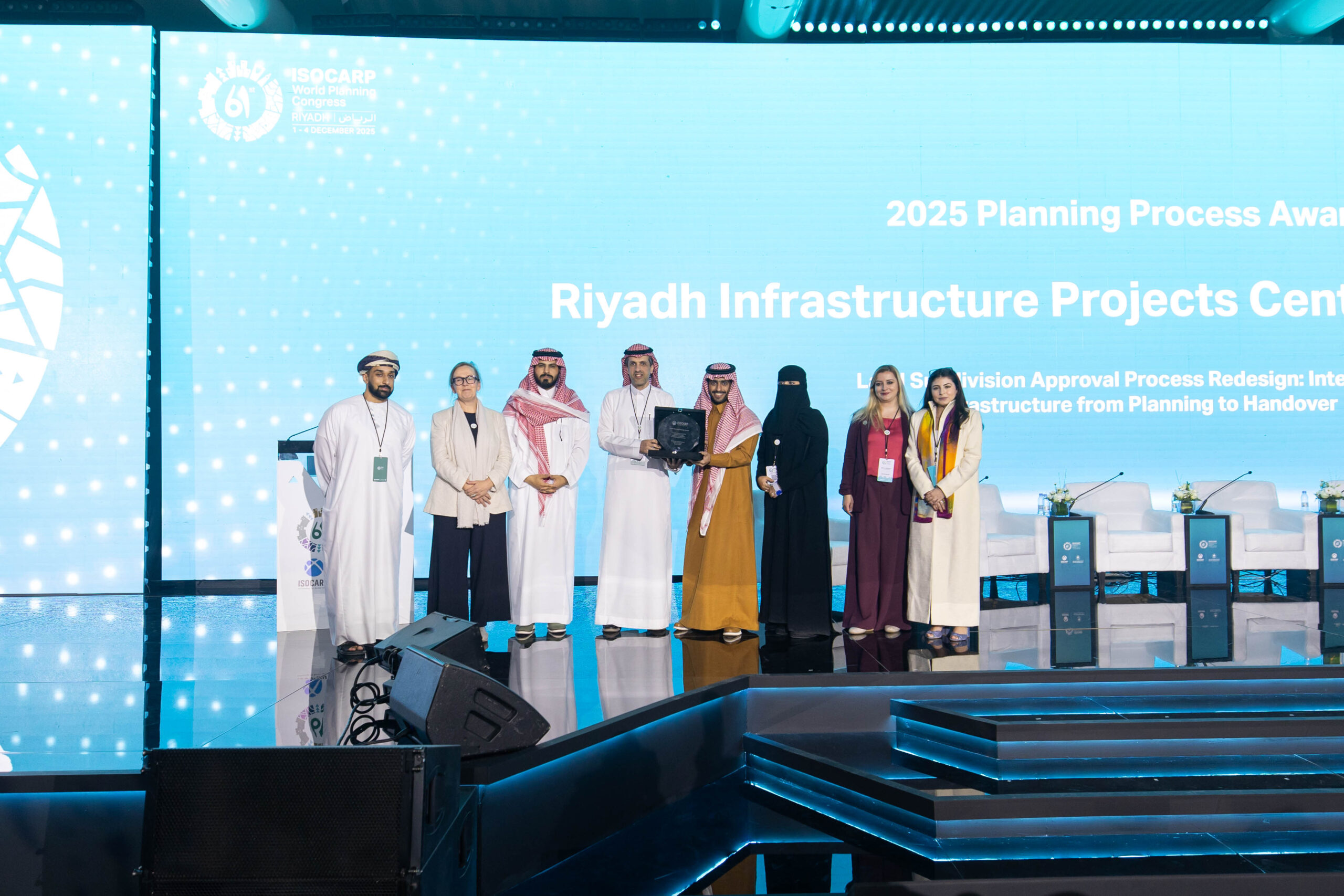
Riyadh Infrastructure Projects Center, 2025 Planning Process Award Winner
©Riyadh Region Municipality
In 2025, a total of 4 eligible entries were submitted:
- Land Subdivision Approval Process Redesign: Integrated Infrastructure from Planning to Handover by Riyadh Infrastructure Projects Center
- Micro-Regeneration of Shared Gardens in a Traditional Fishing Community Under the “Co-Creation” Concept: Multi-Party Co-Governance and Sustainable Renewal in Jiangxinyuan Community of Wuhan by Jizhong Shao
- Future Perspective Doel by Landscape architecture and Urbanism office OMGEVING
- Planning Process for the Social Initiatives for Socio-Economic Masterplan by The Royal Commission for AlUla
Jury
The jury was formed by experienced practitioners and academics: William Anderson, Pia Carrasco, Opeyemi Akintola, and Haydee Jacklyn Malubay
Planning Process Award Winner:
Riyadh Infrastructure Projects Center
Land Subdivision Approval Process Redesign: Integrated Infrastructure from Planning to Handover
In Saudi Arabia, regulations require developers to obtain masterplan approvals following the provision of complete infrastructure. Riyadh’s rapid urban expansion has intensified development demand, prompting a redesign of the Land Subdivision Approval Process. This process, involving various government agencies, utility providers, developers and others, required revision to address current challenges, including incomplete infrastructure, post-execution issues, poor compliance, and HS&E concerns, all of which have negatively impacted the city’s landscape and quality of life. Our project focused on redesigning the process in a participatory manner to promote integrated infrastructure from planning to handover. Its success was rooted in its collaborative approach involving multiple stakeholders, which ensured a diverse range of perspectives and early consideration of implementation realities. A central innovation was the digital platform, coupled with capacity building, which enhanced transparency, efficiency, and fairness in outcomes while promoting scalability. The updated process lays the foundation for sustainable and resilient communities.
Planning Process Award Special Mention:
Wuhan Natural Resources Conservation and Utilization Center, Huazhong Agricultural University, Hanyang District Bureau of Natural Resources and Urban-Rural Development, Wuhan city
Team Member List: Jizhong Shao, Yanxin Li, Yun Wang, Siqiao Liu, Li Zhang, Hao He, Yuansheng Wu, Jiali Zhang, Yan Du, Xin Xia, Zongling He, Yu Chen, Chen Zhang, Yue Xiao, Haiyan Xia, Yarong Jiang, Xiaoyi Xing, Xiaotian Yang, Peng Xu, Yun Wang, Danping Chen, Yuwen Zhou
Micro-Regeneration of Shared Gardens in a Traditional Fishing Community Under the “Co-Creation” Concept: Multi-Party Co-Governance and Sustainable Renewal in Jiangxinyuan Community of Wuhan
As a model of “village-turned-community,” Jiangxinyuan in Hanyang District, Wuhan, has faced issues including deteriorating and enclosed public spaces, disorganized greenery with low biodiversity, outdated facilities, poorly designed spaces for seniors and children, weak sense of belonging from residents, and disconnection between rural heritage and urban settings since 2009. The program adopted a “government-guided, expertise-empowered, resident-engaged” co-creation approach. Over 7,000 sqm of scattered idle spaces were transformed into all-age-friendly shared gardens. By integrating intangible cultural heritage (ICH) elements, the project enhanced physical environments while rebuilding cultural identity. This formed a replicable renewal paradigm that is “low-cost, high participation, eco-friendly, culture-activated” benefiting over 20,000 residents and inspiring replication across the district.
Congratulations to the winners, and a big thank you to everyone who submitted an entry.