Background
The Student Award (SA) addresses a bachelor and/or master student or student group with outstanding results in a related field to urban and regional planning. As a form of ISOCARP’s recognition of the efforts by future planning professionals, the award is bestowed for final design projects, theses, studio projects, etc.
Award winners were announced during an official ceremony at the 61st ISOCARP World Planning Congress in Riyadh, Kingdom of Saudi Arabia, in December 2025.
©Riyadh Region Municipality
Eligible Entries
In 2025, a record number of 53 entries were submitted:
- Lushannan Placemaing by Qi Xia
- Urban Climate Education: an international study of built environment higher education by Olivia Herrmann
- urban610 by David Arazi
- SPATIAL STRATEGY TO REGENERATING A SHRINKING TOWN: THE CASE OF SKUODAS by Aistė Pakamorytė
- Egyption tsunami contengency plan by Shaimaa Mahmoud Elmowafy
- Landscapes of resilience: Adaptive planning of green open spaces in Norman Creek, Australia by Imane Saidi
- Reclaiming Karama | Jane Jacobs in Dubai by Lucie Salou, Marieh Khalighinasab, Sima Assaf and Alia Taher
- Concept Plan and Urban Design for Core Area of the Xiaoyao Bay International Business District in Dalian by Yanpeng Shi and Daming Xu
- Urban central kitchen:Harbin “central kitchen” agricultural and sideline products industrial chain by jilin zhang
- Implementing and Reflecting on Harbin Institute of Technology’s Warm Corridor System Planning through a Climate-Responsive Lens by 正娇 刘, “婧媛 王, 吴松涛
- Mapping Resilience to Compound Events in a Global Metropolis: A Case Study of Riyadh, Saudi Arabia by Alissa Murray
- AgriStitch by Hikmet Eda Akbas and Sevval Bayir
- The Sauna-Shelter: Redesigning Bus Stations For Cold-Weather Cities by Luley Osman and Carolina Rios
- Frozen soil rejuvenates, ice city prospers by Dongyong Wei, Yueyan Qiu, Xi Zuo and Xuwen Wei
- The Rebirth of the Aral Sea by YIFEI MU
- The Protection and Renewal Design of Beijing Chunshu Historical District Based on the Narrative Layering Theory by Heya Na, Shuo Zhou, Jiayu Hong
- The City Of Safety by Shuai Yan GUO, ZiXuan LI, Zhen Qiu, Xiang Yao
- Beyond Rediscovery: Alijan Jute Mill’s Future by Fatiha Tanjim Oni
- Al Mafraq Cultural Trail Project by Osama Al Arqan
- The stairscape by elbin eldho
- The influence of the urban environment on the travel behavior of citizens and the types of spatial mobility in Almaty by Dana Yessengazy and Guzal Akhmetova
- An Integrative Analysis of Water and Climate Adaptation Governance in Bengaluru, India by Sudev Madhav Dileep
- LAR-Go: Local Act for Resilient: Golyazı in Apollonia by Melike Cengizhan
- Benua Etam Lestari: A Sustainable Transit Village for Indonesia’s New Capital through GIS Analysis and Smart Growth Projection by Sabrina Fatiannur, Calistha Azaria, Calistha Azaria and Kenar Putra Iswahyudi
- CANOPY SHELTER by Lin Ma, Rui Liu, Yue Liu, Yi Ren
- CITIES IN SYMBIOSIS: LIVING WITH FIRE by Reza Farhadi, Maryam Norouzi, Amir Rahsaz, Mahshid Del Avar and Hengameh Ghasemi
- From Roots to High-Rise: The Role of Place Attachment in Shaping Housing Satisfaction in Kampung Susun Akuarium, Jakarta by Vimala Audira Dewi
- ORIGIN. heritage revival and agritourism hub by samar Al.khoshman
- SPATIAL DESIGN- User Centric Dwelling Design by Tavishi Mishra
- SPATIAL DESIGN: User Centric Dwelling Design by Aadi Potey
- Regeneration for Communities by Gabriel Pascoal
- Infrastructres of Care in Borderlands by Mihir Bhagat, Nikita Mahajan, David Peralta
- After the Ruins: The Evolution of Housing Policy in Türkiye Since the 2023 Kahramanmaraş Earthquakes by Muram Bacare
- Adaptive Reuse Assessment: Revising Redevelopment Policies in Denver, Colorado to Promote Sustainability by Victoria Lindenmuth
- Echoes of the Canal:Landscape Planning for the Revitalization of Zhedong Canal by Yueyan Qiu, Dongyong Wei, Xi Zuo, Xuwen Wei
- Design of the Circular University Innovation and Entrepreneurship Ecosystem by Xuwen Wei
- A Plan to Stitch the City : Future Smart Community Where Urban Resilience and Quality of Life Thrive Together — Rooted in Urban Resilience Gaps Research by Guangfeng Zhai
- Reimagining Urban Flood Management: Role of Nature-Based Solutions and Public Engagement in Restoring the Yamuna River, New Delhi, India by Riyazul Samad Binmohammad
- Ice Point Ligament: Cold Region Sustainable Resilient Wetland Landscape Design Based on In-Situ Biological Restoration Technology by Heya NA, Zhou Shuo and Lu Senting
- STUDY ON THE INFLUENCE MECHANISM AND OPTIMIZATION STRATEGY OF URBAN GREEN SPACE PATTERN ON NOISE DISTRIBUTION by MINGFENG ZHANG
- PASSING THE TORCH, CONTINUING THE LEGACY: Sustainable Planning for Urban RedCultural Heritage by MINGFENG ZHANG, JIANI JIANG, BOYI CUI, BOWEN LI
- Organic Community by Yalin Li, Tingting Shi, Wang Qingying
- Housing in European Metropolises: Supply dynamics and planning frameworks in large Urban Areas of the EU by Mikel Berra Sandin
- The Green Line Community by Hamzah Alomari, Sadeen Almadi, Sara Zamili, Jood Bani Omar
- FLOATING VEILS, FADING EDGES by MINGFENG ZHANG, WENKAI LIU, GUANG YANG, FENGCHEN ZHU, FENGYI XU
- Weaving Liquid Veins: Reimagining Village Resilience through Khal Networks in the Sundarbans by DEBANJALI PAUL
- Integration of Riyadh’s Megaprojects by sara almubarak
- The Impact of Urban Renewal on Economic Activities in the City Centers: Central of Mahayil Asir, a case study by Amer Albariqi, Waleed Alzamil
- An Economic & Tourist Vision for The Centers of Jazan Region by Maha Alqahtani
- Majmaah Structural Plan (2023-2050) by Salem Alqahtani, Abdulrhman Alhomoud
- Strategic Planning for Integrating Public Space Systems with Major Parks in Riyadh by Lujain Aldosari
- Calumet: Off the Grid – A New Delta by Zihao Tang, Dimitri Nesbitt, John Mack, Aesha Acharya, Joshua Fraser, George Perkins, Ashley McKnight, Disha Chande, Clare Colvin, Kshitij Sriperambuduru, Aubrey Hills, Dr. Sevin Yildiz, Phil Enquist, Symphony Malveaux, Dr. April Jackson
- JAKARTA – THE URGENT CALL by MAJA MAWUSI, María José Schmidt, Sanjaykumar Venkateshbabu
Jury
The jury was formed by experienced practitioners and academics: Keru Feng, Federica Fiaco, and Lamis El Khatieb
Winner
A Plan to Stitch the City : Future Smart Community Where Urban Resilience and Quality of Life Thrive Together — Rooted in Urban Resilience Gaps Research, by Guangfeng Zhai
The Plan to Stitch the City: Based on research on resilience gaps in waterlogged communities, new migrant communities, and urban villages, The Plan to Stitch the City addresses urban resilience issues such as spatial fragmentation, social alienation, ecological imbalance, and digital divide, as well as the pain point of insufficient intergenerational adaptability. With “intergenerational integration” as the thread, it builds a four-dimensional stitching system covering space, society, ecology, and digital aspects. Through measures like three-dimensional composite spaces, intergenerational co-governance, flexible facilities, and inclusive digital platforms, it creates a future all-age-friendly community where resilience and quality of life coexist, providing a replicable action-oriented urban renewal model.
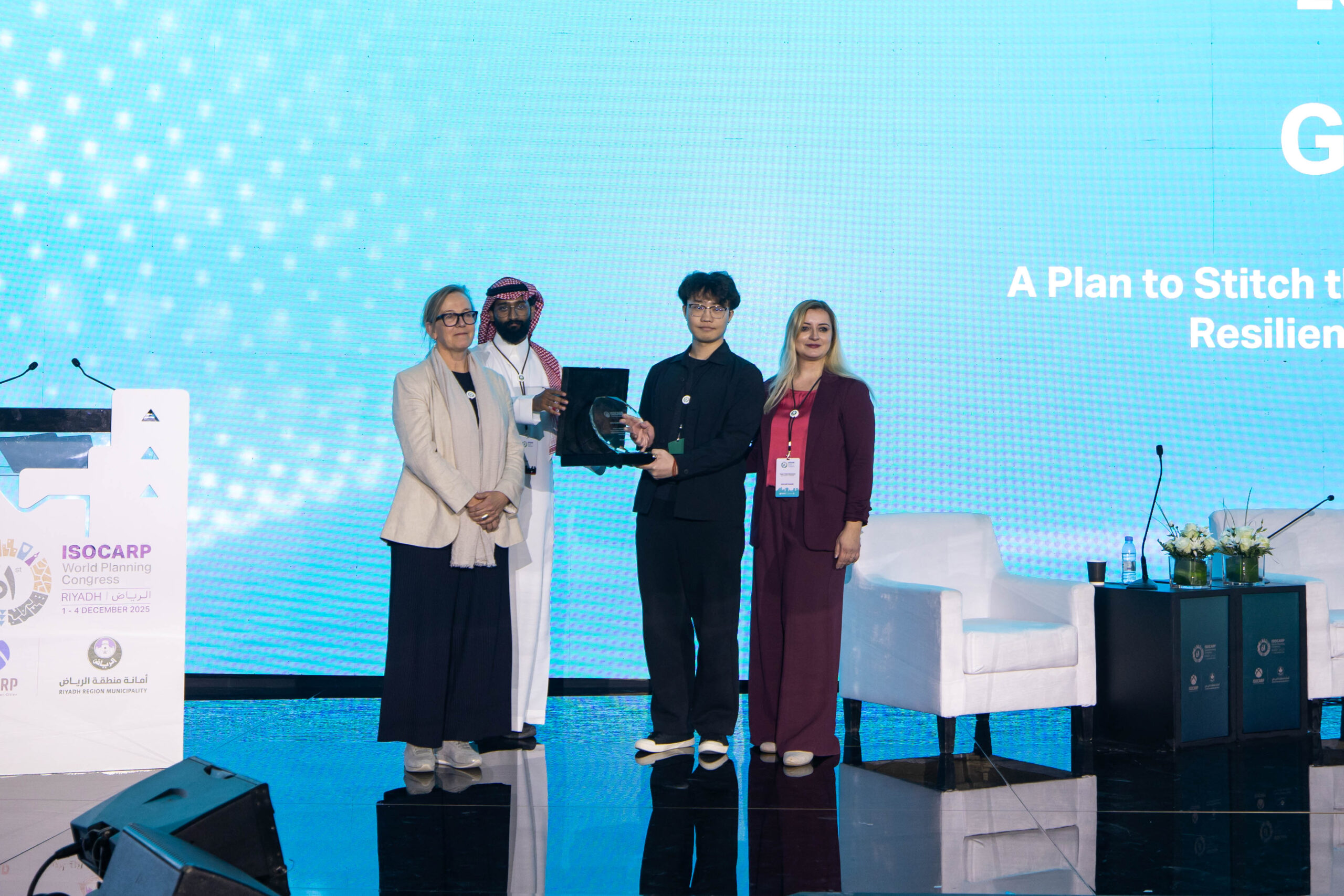
Guangfeng Zhai, 2025 Student Award Winner
©Riyadh Region Municipality
Special Mention
Weaving Liquid Veins: Reimagining Village Resilience through Khal Networks in the Sundarbans, by Debanjali Paul
Weaving Liquid Veins: Reimagining Village Resilience through Khal Networks in the Sundarbans examines how villages in the Sundarbans, home to the Royal Bengal Tiger, can survive and thrive amid relentless cyclones, tidal surges, and rising salinity. For generations, villagers have relied on “khals” (Tidal creeks) that act as lifelines, sustaining water, biodiversity, culture, and livelihoods. Today, these waterways are increasingly disrupted by embankments, land reclamation, unplanned settlements, and siltation, leading to water stagnation, salinity intrusion, and livelihood decline. Traditional village layouts alone are no longer sufficient to withstand these pressures. This thesis proposes a resilient village framework that revives and revitalizes khal networks, establishes ecological buffers, incorporates community engagement spaces, and integrates flood resilient housing with eco-sensitive infrastructure. By reconnecting settlements to the water network and preserving ecological and cultural assets, the study presents a climate adaptive, water-sensitive blueprint for villages to endure, prosper, and harmonize life, work, and culture within the dynamic Sundarbans delta.
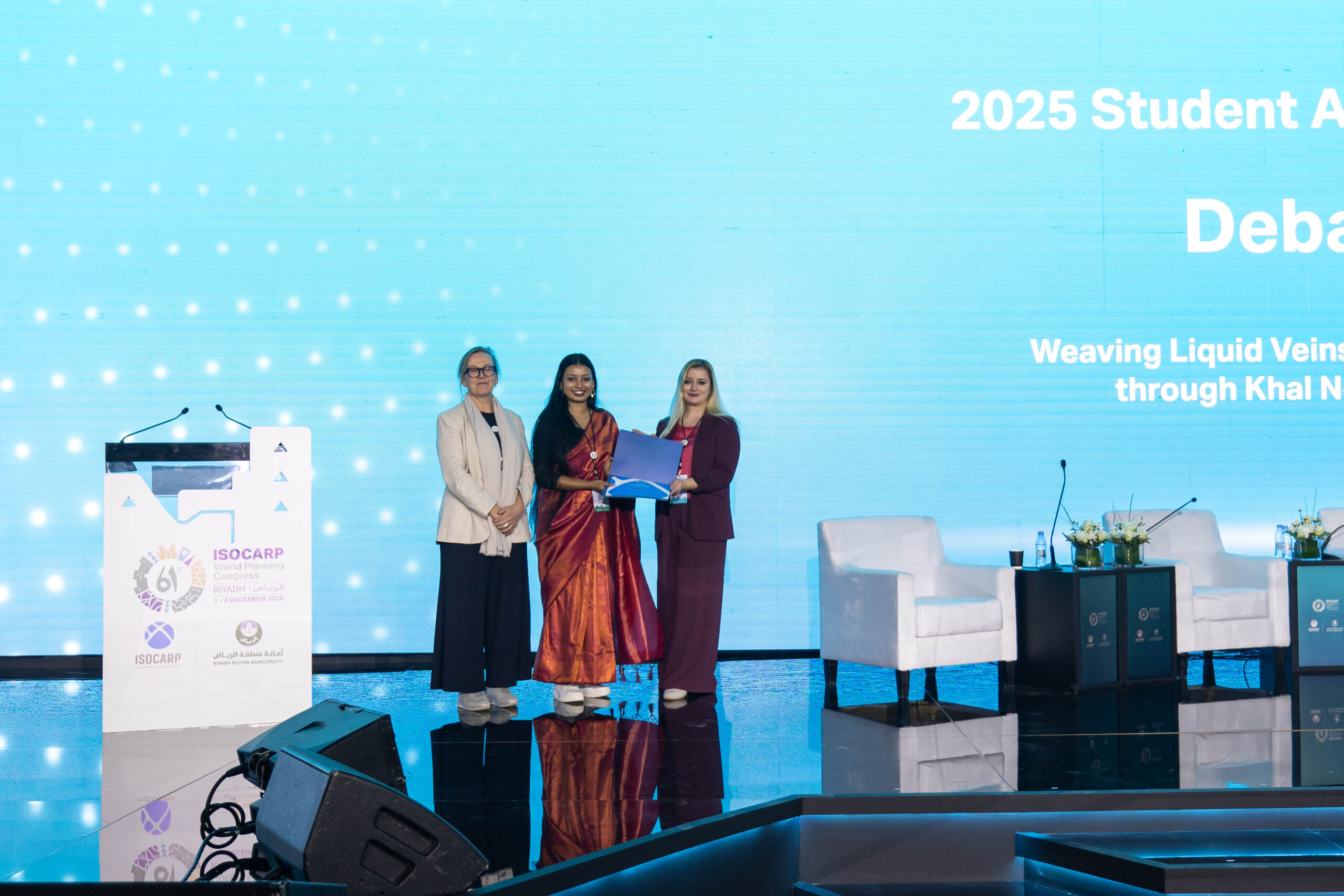
Debanjali Paul, 2025 Student Award Special Mention
©Riyadh Region Municipality
Congratulations to the winners, and a big thank you to all students who shared their work with us!
We look forward to receiving many successful SA submissions again next year.