Kaitiakitanga –  New Balances through Planning in the Age of Uncertainty

27–30 April 2027, Wellington, New Zealand

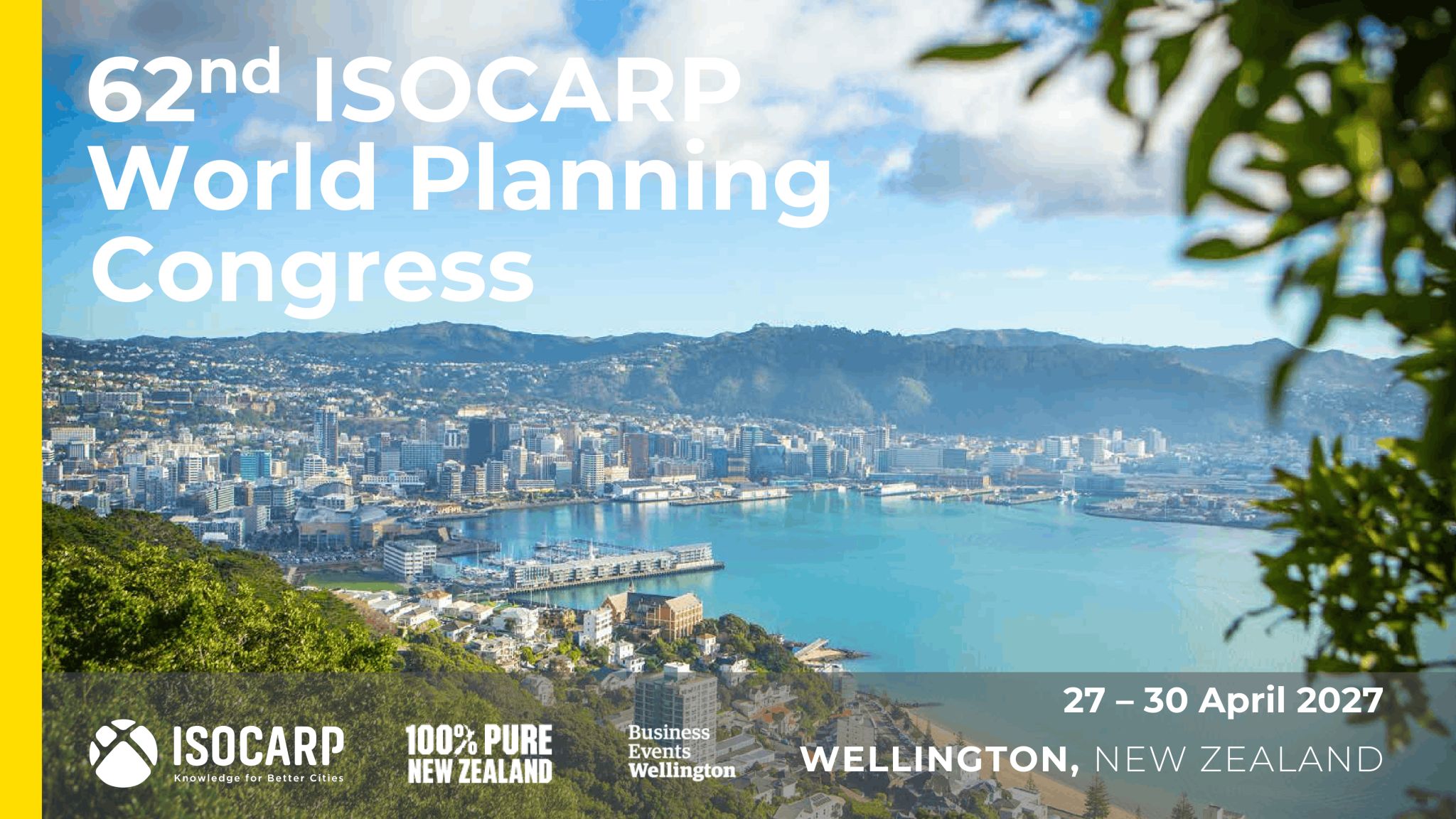
ISOCARP is delighted to announce that the 62nd ISOCARP World Planning Congress (WPC62) will be hosted in Wellington, New Zealand, from 27 to 30 April 2027, bringing a global community together to focus on vital topics in city and regional planning, including sustainable urban development, equity, regenerative practices, technology, and climate change.

Around 500 city planners, policymakers, academic researchers, and urban innovators are expected to attend the world congress, which will take place at Tākina Wellington Convention & Exhibition Centre.

The Congress will be delivered in partnership with our co-host, the City of Wellington, alongside valued partners including WellingtonNZ, Te Herenga Waka—Victoria University of Wellington, Business Events Wellington, and Tourism New Zealand Business Events.
As one of the world’s leading gatherings of urban and regional planning professionals, the ISOCARP World Planning Congress provides a unique platform for exchanging ideas, showcasing innovative practices, and addressing the pressing challenges shaping cities and regions today. WPC62 will bring together planners, urban designers, policymakers, academics, researchers, and development practitioners from across the globe to engage in meaningful dialogue and collaborative learning.

Set against the backdrop of New Zealand’s vibrant capital city, the Congress will offer participants an opportunity to explore Wellington’s distinctive urban character, sustainability initiatives, and forward-thinking approaches to planning and development. Elisabeth Belpaire, President of the International Society of City and Regional Planners (ISOCARP), says: “New Zealand offers a globally significant vantage point from which to rethink the future of cities and regions”.

“At a time of accelerating biodiversity loss, climate change, social and geopolitical uncertainty, hosting the 62nd ISOCARP World Planning Congress in Wellington places the Pacific at the centre of the conversation – where questions of resilience, regeneration, indigenous knowledge, and spatial equity are not abstract, but lived realities. This is precisely the kind of grounded, forward-looking context that the global planning community must engage with now.”

ISOCARP warmly invites urban professionals, public officials, researchers, and development partners to join us in Wellington for an inspiring exchange of ideas, strategies, and experiences.

Kaitiakitanga – New Balances through Planning in the Age of Uncertainty

The Congress theme is developed in dialogue with Māori knowledge holders and mana whenua. The whakataukī offers an opening for reflection, more than fixed interpretation, inviting us to consider what it means for planning in an uncertain world.

We are entering a new era of planning; one that calls for decisions made not for a single election cycle, but for the generations who inherit them. Climate change, housing pressures, biodiversity loss and widening inequality are redefining how cities and regions evolve. Urban and rural areas, long bound by shared settlement, food, water and resource systems, now face growing strain even as their interdependence deepens.

These interconnected challenges invite a fundamental question: How can we find new balances through planning in a rapidly changing world?

The Congress draws inspiration from Kia whakatōmuri te haere whakamua — I walk backwards into the future, with my eyes fixed on the past — inviting us to balance the knowledges of the past as we transform for the future. We invite the global planning community to Wellington, Aotearoa New Zealand, to explore this question through the guiding principle of Kaitiakitanga.

More than stewardship, Kaitiakitanga is a responsibility to care for people, place and the living world, recognising our obligations to future generations. The approach is deeply woven across all programme tracks. Where planning is too often shaped by short electoral and budgetary cycles, it asks us to plan deliberately for those who inherit our decisions decades from now, moving beyond conventional sustainability towards a genuinely regenerative, long-term perspective.

Hosted in Aotearoa New Zealand, the Congress offers a unique opportunity to learn from Indigenous knowledge systems that have long understood the relationships between land, water, communities and wellbeing, explored alongside planning traditions from every continent, Indigenous and non-Indigenous alike, recognising that not every land shares the same knowledge traditions, and that planning’s future depends on genuine dialogue across this diversity.

62nd ISOCARP World Planning Congress
0
0
0
0
Days
0
0
Hrs
0
0
Min
0
0
Sec

Congress Tracks

Housing lies at the heart of the social, economic and environmental transformations reshaping cities and regions worldwide. Yet the challenge extends beyond the provision of dwellings. Housing is a deeper concept that embeds deeper meanings and that involves a wide diversity of factors attached to it. Questions of affordability, access, health, mobility, belonging and opportunity are increasingly interconnected, shaping how individuals and communities experience everyday life. In an era of uncertainty, planning must confront the uneven distribution of these opportunities and burdens, recognising that the places where people live profoundly influence their ability to thrive.

This track explores how planning can contribute to more just, liveable and caring futures by addressing the spatial inequalities that continue to exclude many communities from decision-making and from the benefits of urban development. It invites critical reflection on how housing, diversity, wellbeing and social inclusion are understood, measured and delivered across different contexts. Contributions may examine transformative approaches to spatial justice, community participation, place-based planning, social infrastructure and inclusive urban transformation, while considering how planning can create conditions for flourishing communities across generations.

Climate change presents a profound challenge to conventional planning approaches. Increasing exposure to extreme heat, environmental degradation, biodiversity loss and climate-related hazards reveals the limitations of linear models of decision-making and highlights the need to engage more deeply with complexity, uncertainty and systemic change. As the relationships between social, ecological and economic systems become increasingly apparent, planning is called upon not only to reduce vulnerability but also to support the conditions for long-term regeneration.

This practice-oriented track examines how planners, communities and institutions are responding to climate change through action on the ground. It welcomes contributions that engage with complexity, adaptation, regenerative approaches, system thinking and resilience from a holistic perspective (including social, cultural, governance, economic and environmental aspects). We invite these contributions to recognise the feedback loops and interdependencies that shape contemporary urban and regional challenges. Particular emphasis is placed on translating knowledge into practice whilst understanding how practices shape knowledge, bridging strategic ambition with implementation, and exploring how planning can foster transformative responses that strengthen both human and more-than-human systems.

Urban and rural areas are frequently conceived as separate planning domains, despite being linked through complex and enduring relationships. Food, water, energy, ecosystem services, labour, culture and mobility all flow across territorial boundaries, creating forms of interdependence that are increasingly significant in a period of environmental, economic,social and cultural transition. Recognising these connections is fundamental to understanding how places function and how their futures are shaped.

This track considers how planning can strengthen the relationship between urban and rural areas as part of a shared and interconnected system. It invites contributions that explore regional futures, territorial governance, multilayered landscape planning, material flows and circularity, Indigenous stewardship, deep life-centred adaptation, ecological resilience and the evolving relationships between generations of people and place. Particular attention is given to approaches that move beyond traditional binaries and seek more integrated ways of understanding and managing the interdependencies that underpin regenerative and prosperous regions.

Contemporary planning challenges rarely respect their designated administrative and political boundaries. People, knowledge, finance, resources and environmental impacts move through increasingly complex networks that connect places across multiple scales and localities. These flows create new forms of interrelationships, revealing how local decisions are shaped by, and in turn shape, processes occurring elsewhere. In this context, planning requires governance approaches capable of enacting relational foresight while balancing it in real time with a sense of political urgency.

This track explores the implications of translocality for planning and governance. It welcomes contributions that examine how institutions, communities and practitioners navigate the networks and systems, flows and lateral connections that increasingly influence urban and regional development. Topics may include collaborative governance, participation, policy learning, mobility, migration, cross-boundary planning and new forms of collective action. The track seeks to advance understanding of how formal and informal governance can respond to complexity while fostering shared responsibility for places, diverse communities and future generations that are increasingly interconnected.

Technological innovation is transforming the ways in which cities and regions are planned, governed and experienced; it is shaping how places are thought of and constructed. From artificial intelligence and advanced data analytics to digital participation and emerging forms of urban intelligence, technological change offers significant opportunities to support decision-making and address complex challenges. However, these developments also raise important questions concerning power, representation, equity and whose knowledge is valued in shaping the future.

This track invites a critical and reflective examination of technological innovation through the lens of humility, ethics and care. Rather than reproducing simplistic distinctions between the Global North and Global South, it seeks to explore how diverse planning traditions, cultural contexts and knowledge systems can contribute to more inclusive and responsible technological futures. Contributions may consider the opportunities and limitations of digital transformation, the governance of emerging technologies, data justice, Indigenous and local knowledges, and the evolving relationship between human judgement and technological capability. At its core, the track asks how innovation can meaningfully serve people, place and future generations.

Call for Congress Team Members – Applications Closed

Dear ISOCARP members and ISOCARP friends,

Thank you to everyone who submitted an application for the upcoming 62nd ISOCARP World Planning Congress. The deadline to apply for the Track Rapporteur positions was 5 October 2026, and applications are now officially closed.

Every year, General Rapporteurs and Track Rapporteurs make our congress possible by bringing their expertise to curate the content of tracks, create and moderate quality sessions and engage participants in the productive conversations that are at the heart of the ISOCARP events. We sincerely appreciate the strong interest and dedication shown by applicants from the public, private, and academic sectors worldwide.

Our team is currently reviewing all submissions and will be contacting selected applicants soon.